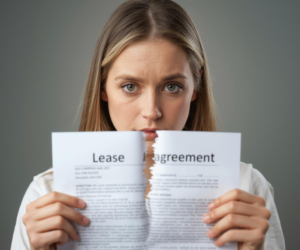
Few things catch a landlord off guard faster than a message saying a tenant plans to move out early.
When that happens, confusion often follows: Can you charge for the rest of the lease? Can you keep the deposit? What if new tenants move in right away?
In BC, the answers are governed by the Residential Tenancy Act (RTA), not by assumptions, frustration, or what someone once said in a Facebook group.
This article explains your rights, your obligations, and some of the most common myths landlords encounter when a tenant breaks a fixed-term tenancy, with a light touch of humour and a strong focus on what the law actually says.
Is the Lease Really “Broken”?
In BC, a fixed-term tenancy is legally binding unless one of the following applies:
- The tenancy agreement allows early termination
- Both parties mutually agree to end the tenancy
- The tenant qualifies for a legal early end under the RTA (for example, family violence, long-term care, or death)
If none of these apply and the tenant leaves anyway, the lease has been broken in legal terms. However, that does not automatically entitle a landlord to unlimited compensation.
Common Myth #1: “The tenant owes rent for the rest of the lease, no matter what.”
This is one of the most persistent misunderstandings — and one of the fastest ways to lose at dispute resolution.
A tenant may be responsible for lost rent, but only if the landlord makes reasonable efforts to re-rent the unit. This is known as the duty to mitigate loss.
What mitigation means in practice:
- Advertising the unit promptly
- Setting a reasonable rent
- Accepting a suitable replacement tenant
- Not leaving the unit vacant intentionally
If the unit is re-rented quickly, the former tenant’s responsibility for rent usually ends at that point.
Common Myth #2: “I can just keep the damage deposit.”
The damage deposit does not automatically become compensation for a broken lease.
Under the RTA, a deposit may only be applied to:
- Unpaid rent, or
- Actual damage beyond normal wear and tear
And even then, only if:
- The tenant agrees in writing, or
- You obtain an order from the Residential Tenancy Branch
Keeping a deposit without proper authority can result in an order to repay double the amount.
What Landlords Can Legally Do When a Lease Is Broken
When handled correctly, landlords do have enforceable options.
Claim lost rent
If the unit remains vacant after reasonable efforts to re-rent, you may apply to the RTB to recover the lost rent.
Claim reasonable re-rental costs
In some cases, advertising or other reasonable expenses related to re-renting may be recoverable.
Re-rent the unit
Once the tenant has vacated and returned possession, the tenancy is over and the unit may be rented to new tenants.
Apply for dispute resolution
If there is a disagreement about money owed, the RTB is the appropriate forum to resolve it.
Common Myth #3: “I can refuse new tenants so the old tenant keeps paying.”
Landlords are not permitted to reject suitable applicants simply to continue claiming rent from a former tenant.
Doing so is generally considered a failure to mitigate loss and is unlikely to be viewed favourably by the RTB.
Best Practices for Landlords
If a tenant breaks a lease, good documentation and reasonable conduct are your strongest protections.
Consider:
- Recording the date possession was returned
- Advertising the unit promptly
- Keeping copies of listings and correspondence
- Showing the unit to suitable applicants
- Communicating clearly and professionally, preferably in writing
These steps are not just good management practices – they also provide valuable evidence if a dispute arises.
Key Takeaways
When a tenant breaks a lease in British Columbia:
- Landlords have rights, but also legal obligations
- Compensation is tied to actual loss, not the remaining lease term
- Reasonable effort and clear documentation matter
The Residential Tenancy Act does not favour one side over the other. It rewards fairness, transparency, and compliance with the rules.
Understanding those rules in advance can save landlords time, money and unnecessary stress.